

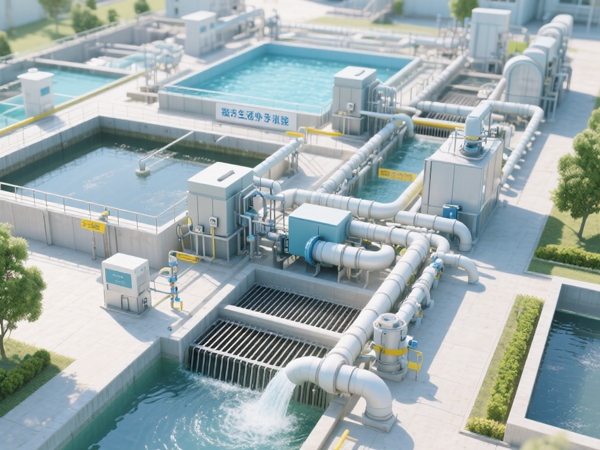


Composition of Sewage Treatment Systems
Pretreatment Stage
Pretreatment is the first barrier in sewage treatment. Its main task is to remove larger suspended solids, floating substances, sediment and other impurities in the sewage to protect the normal operation of subsequent treatment equipment and reduce their treatment load. Common equipment in this stage includes grilles. Through grille interception, large debris such as branches, plastic bottles, and fabrics in the sewage can be removed. Grit chambers use the principle of gravity sedimentation to make inorganic particles such as sand in the sewage settle. For example, in urban sewage treatment plants, sewage first flows through grilles. Coarse grilles intercept larger debris, fine grilles further remove smaller particles, and then enter the grit chamber to effectively remove sand, laying the foundation for subsequent treatment. This stage is applicable to various types of sewage such as domestic sewage, municipal sewage, and industrial wastewater, and is an important prerequisite for ensuring the stable operation of the entire treatment system.
Main Treatment Stage
The main treatment stage is the core link of sewage treatment. According to the nature of the sewage and treatment requirements, various physical, chemical, and biological methods are used to deeply remove pollutants in the sewage. For domestic sewage, food processing wastewater and other sewage containing a large amount of organic pollutants, biological treatment methods are widely used. Among them, the activated sludge process is a typical representative. In the aeration tank, activated sludge is fully mixed with sewage, and microorganisms use organic matter in the sewage as a nutrient source for metabolism, decomposing it into harmless substances such as carbon dioxide and water to achieve sewage purification. For heavy metal ions, refractory organic matter, etc. in industrial wastewater, chemical treatment methods such as coagulation precipitation and neutralization reactions play a key role. For example, in electroplating wastewater treatment, heavy metal ions are precipitated by adding chemical agents.
Advanced Treatment Stage
After the main treatment, although most pollutants in the sewage have been removed, it may still contain a small amount of nutrients such as nitrogen and phosphorus, as well as refractory organic matter and trace heavy metals, which cannot meet strict discharge or reuse standards. The advanced treatment stage is to further remove these residual pollutants. Common advanced treatment technologies include filtration, which removes fine particles and some organic matter in water through sand filtration, activated carbon filtration, etc. Membrane separation technologies, such as reverse osmosis and ultrafiltration, can effectively intercept bacteria, viruses, small molecule organic matter, heavy metal ions, etc., greatly improving water quality to meet reuse requirements, and are often used in reclaimed water reuse systems. In some industrial productions with high water quality requirements, the water after advanced treatment can be reused as production water, realizing the efficient utilization of water resources.
Process Selection for Sewage Treatment Systems
Process Adaptation for Different Sewage Types
Different types of sewage require different treatment processes due to their differences in composition and properties. Domestic sewage has relatively stable composition, and the pollutants are mainly organic matter, nitrogen, phosphorus, and microorganisms. It mostly adopts biological treatment - based processes, such as the A²/O process (anaerobic - anoxic - aerobic process), which can simultaneously achieve organic matter degradation, nitrogen and phosphorus removal. Industrial wastewater is complex and diverse. Chemical wastewater may contain a large amount of toxic and harmful organic matter and heavy metals; printing and dyeing wastewater has the characteristics of high chroma and high chemical oxygen demand (COD). For chemical wastewater, a combined process of physicochemical pretreatment and biological treatment is often used. First, some toxic and harmful substances are removed by physicochemical methods such as extraction and adsorption to improve the biodegradability of the wastewater, and then biological treatment is carried out. Printing and dyeing wastewater treatment often adopts the process route of coagulation precipitation - biological treatment - advanced oxidation. Coagulation precipitation removes most suspended solids and some organic matter, biological treatment further degrades organic matter, and advanced oxidation such as Fenton oxidation removes refractory organic matter and chroma.
Factors Affecting Process Selection
When selecting a sewage treatment process, a variety of factors need to be considered comprehensively. The quality and quantity of sewage is one of the key factors. Sewage with complex water quality and large quantity fluctuations requires a process with strong adaptability and flexible treatment capacity. The treatment target is also crucial. If strict discharge standards or even reuse standards are required, more advanced treatment processes and advanced treatment links need to be adopted. Economic costs cannot be ignored, including construction costs, operation costs, and maintenance costs. For example, biological treatment processes are relatively low - cost, but their treatment effect on some special pollutants may be limited; while membrane treatment processes have good treatment effects, but the equipment investment and operation costs are high. In addition, site conditions and local environmental protection policies and regulations will also affect the process selection. In urban areas with tight land resources, there may be a greater tendency to choose integrated treatment equipment and processes with small floor space.
Key Equipment and Technologies of Sewage Treatment Systems
Grille and Grit Removal Equipment
Grilles, as key equipment for pretreatment, are divided into coarse grilles and fine grilles. The spacing of the bars of coarse grilles is relatively large, generally 50 - 100mm, which is mainly used to intercept large floating objects and suspended solids, such as branches and garbage; the spacing of the bars of fine grilles is small, usually 1 - 10mm, which can remove smaller particles, such as fibers and hair. Common types of grilles include plane grilles, curved grilles, and rotary grilles. Grit removal equipment mainly includes advection grit chambers, aerated grit chambers, and cyclone grit chambers. The advection grit chamber has a simple structure, and sand particles settle through the slow flow rate of sewage in the chamber; the aerated grit chamber separates organic matter and sand particles in the sewage through aeration, improving the grit removal effect while pre - aerating the sewage; the cyclone grit chamber uses hydraulic cyclone to make sand particles settle under centrifugal force, which has the advantages of small floor space and high grit removal efficiency.
Biological Treatment Equipment
Biological treatment equipment is the core part of the sewage treatment system. Taking the activated sludge process as an example, the aeration tank is its key equipment. In the aeration tank, air is injected into the mixed liquid through the aeration system to provide sufficient dissolved oxygen for microorganisms, enabling them to efficiently decompose organic matter in the sewage. The aeration system is divided into blast aeration and mechanical aeration. Blast aeration sends air into the aeration tank through blowers through pipes and aerators. Common aerators include microporous aerators and medium - pore aerators, which have the advantages of high oxygen utilization rate and uniform aeration; mechanical aeration transfers oxygen in the air to the sewage through equipment such as aeration impellers installed on the surface of the aeration tank, which has the characteristics of simple equipment and convenient maintenance. In addition, equipment such as biofilters and biological contact oxidation tanks in the biofilm method are also widely used. The biofilter is filled with filter media, and microorganisms attach to the surface of the filter media to form a biofilm. When sewage flows through the biofilm, the organic matter in it is decomposed by microorganisms. The biological contact oxidation tank is equipped with fillers in the tank, where microorganisms grow, and at the same time, aeration is used to make the sewage fully contact with the biofilm to achieve sewage purification.
Advanced Treatment Technologies and Equipment
Filtration equipment in advanced treatment, such as sand filters, removes fine particles, suspended solids, and some organic matter in sewage through the filtration of quartz sand and other filter media. Activated carbon filtration equipment uses the adsorption performance of activated carbon to adsorb odors, pigments, trace organic matter, and heavy metal ions in water. Membrane separation equipment occupies an important position in advanced treatment. Reverse osmosis (RO) membranes can effectively intercept almost all impurities in water, including ions, small molecule organic matter, bacteria, and viruses. The produced water has excellent quality and is often used in the preparation of high - purity water, which is widely used in wastewater reuse in electronics, pharmaceutical and other industries. Ultrafiltration (UF) membranes mainly remove macromolecular organic matter, colloids, bacteria, etc. They have low operating pressure and relatively low operating costs, and are widely used in reclaimed water reuse, drinking water purification and other fields.
Maintenance and Management of Sewage Treatment Systems
Water Quality and Quantity Monitoring
Water quality and quantity monitoring is an important basis for the maintenance and management of sewage treatment systems. By real - time monitoring the water quality indicators of influent, each link in the treatment process, and effluent, such as chemical oxygen demand (COD), biochemical oxygen demand (BOD), ammonia nitrogen, total phosphorus, suspended solids (SS), and the flow of sewage, we can timely understand the operation status of the sewage treatment system. For example, when the influent COD suddenly increases, it may mean that the discharge of industrial wastewater is abnormal, and it is necessary to timely adjust the treatment process parameters or take emergency measures. Water quality monitoring can be carried out by combining online monitoring instruments and laboratory testing. Online monitoring instruments can feedback water quality data in real time, facilitating the timely discovery of problems; laboratory testing can conduct more comprehensive and accurate analysis of water samples, providing a scientific basis for process adjustment. Water quantity monitoring is realized through flow meters, and equipment operation parameters are reasonably adjusted according to flow changes to ensure the stable operation of the system.
Equipment Maintenance and Upkeep
Various equipment in the sewage treatment system, such as grilles, water pumps, aeration equipment, and sedimentation tank sludge scrapers, may experience wear and corrosion after long - term operation, affecting the treatment effect and the normal operation of the system. Therefore, regular equipment maintenance and upkeep are crucial. Equipment maintenance includes daily inspection, regular maintenance, and equipment upkeep. Daily inspection mainly checks the operation status of the equipment, such as whether there is abnormal noise, vibration, and whether the temperature is normal, so as to timely find and solve small faults. Regular maintenance involves a comprehensive inspection, repair, and replacement of vulnerable parts of the equipment in accordance with the equipment's instructions and operation cycle. For example, the aerators of aeration equipment need to be cleaned regularly to prevent blockage; the seals and bearings of water pumps need to be replaced regularly. Equipment upkeep includes cleaning, lubricating, and anti - corrosion treatment of the equipment to extend its service life.
Sludge Treatment and Disposal
A large amount of sludge is generated during sewage treatment. Sludge contains a large amount of organic matter, pathogens, heavy metals, and residual pollutants. If not properly treated, it will cause secondary pollution to the environment. The goals of sludge treatment and disposal are to achieve reduction, stabilization, harmlessness, and resource utilization. Common sludge treatment methods include thickening, dewatering, and digestion. Thickening separates the water in the sludge initially by gravity or mechanical methods to reduce the sludge volume; dewatering further removes the water in the sludge to reduce its moisture content to a certain extent, facilitating subsequent treatment and transportation. Common dewatering equipment includes belt filter presses, plate and frame filter presses, and centrifugal dewaterers. Digestion can be divided into aerobic digestion and anaerobic digestion. Anaerobic digestion can stabilize the organic matter in the sludge while producing biogas (which can be used as energy), reducing the sludge volume and the content of pathogens. The treated sludge can be disposed of according to its nature, such as for land improvement and the production of building materials, to realize the resource utilization of sludge.
Sewage treatment systems are complex and systematic projects. Every link from sewage collection, treatment to discharge or reuse is closely connected. Through reasonable process selection, advanced equipment application, and scientific maintenance and management, sewage treatment systems can effectively cope with the challenges of various types of sewage, and play an important role in protecting water resources, improving the ecological environment, and promoting sustainable development. Whether it is domestic sewage, industrial wastewater, or other types of sewage, they can be properly treated in a sound sewage treatment system, making our water environment clearer and healthier.